
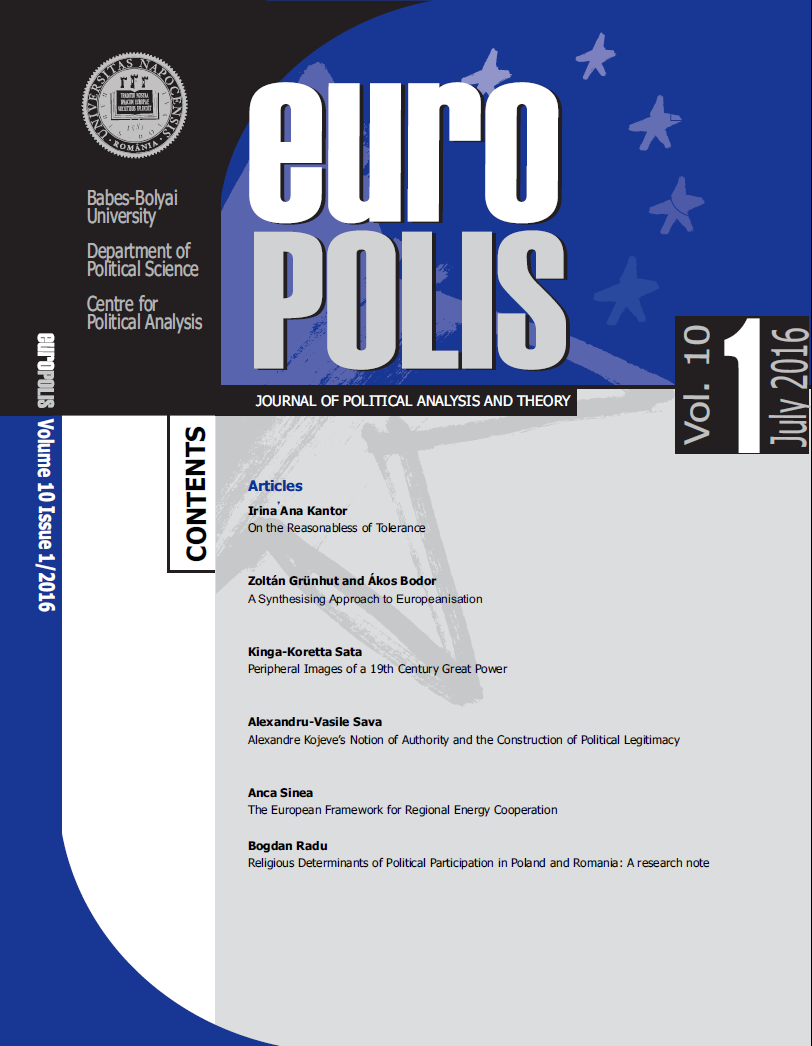
THE EUROPEAN FRAMEWORK FOR REGIONAL ENERGY COOPERATION
THE EUROPEAN FRAMEWORK FOR REGIONAL ENERGY COOPERATION
Author(s): Anca SineaSubject(s): Politics / Political Sciences
Published by: Centrul de Analiza Politica
Keywords: institutions; europe; romania; energy cooperation
Summary/Abstract: The main objective of this article is to define the instituional framework of regional energy cooperation relevant to Romania from a European perspective. The guiding instrument in this affair is TEN-E, which is the footing of the European energy policy. An implicit consequence of this desideratum is to ascertain the criteria defining regional cooperation, its substance, the way these two have evolved over time to the point they are today. Furthermore, it identifies the state actors that form these structures of cooperation and, thus, contribute at influencing and implementing the European policy in the field of energy at regional level. This reasearch questions will support the ensuing attempt at establishing the possible role Romania might play as a regional energy actor and how it can contribute as a factor of balance at regional and European level. In brief, the chapter identifies as actors of regional cooperation the European Commission as the guiding factor, the member states as the subtile actors and the TSOs as the driving factors. Furthermore, the chapter points out the fact that with the EU enlargement, the widening of it’s internal maket perspective and the even more important role the European Neighbourhood plays in EU energy policy, the energy strategy tends to shrink into a more and more structured design. It also evolves from a communitary perspective, where progress is scattered, to a more coherent strategic thinking characterised by larger frames and more comprehensive concepts, which are easier to work with across policies, politically and strategically. These well-designed energy corridors also give a new meaning to regional energy cooperation. The frameworks for intergovernmental dialogue become cornerstones of the common market, and also relevant tools of EU foreing policy as they acquire a geopolitical dimension. Regional energy cooperation structures can mediate the reglationship with third countries (energy producers, transit countries or EU aspirants alike), making of the transfer of the acquis communautaire in a wide range of fields connected to energy one of their main goals, as this is paramount to the functioning of IEM and the energy security of the block. Within these corridors cooperation can be formal or informal, technical or political. Oftentimes there is a need for advanced political engagement, which is being verbalized even in terms of developing political energy regions.
Journal: Europolis, Journal Of Political Science And Theory
- Issue Year: 10/2016
- Issue No: 01 (19)
- Page Range: 85-110
- Page Count: 26
- Language: Romanian
