
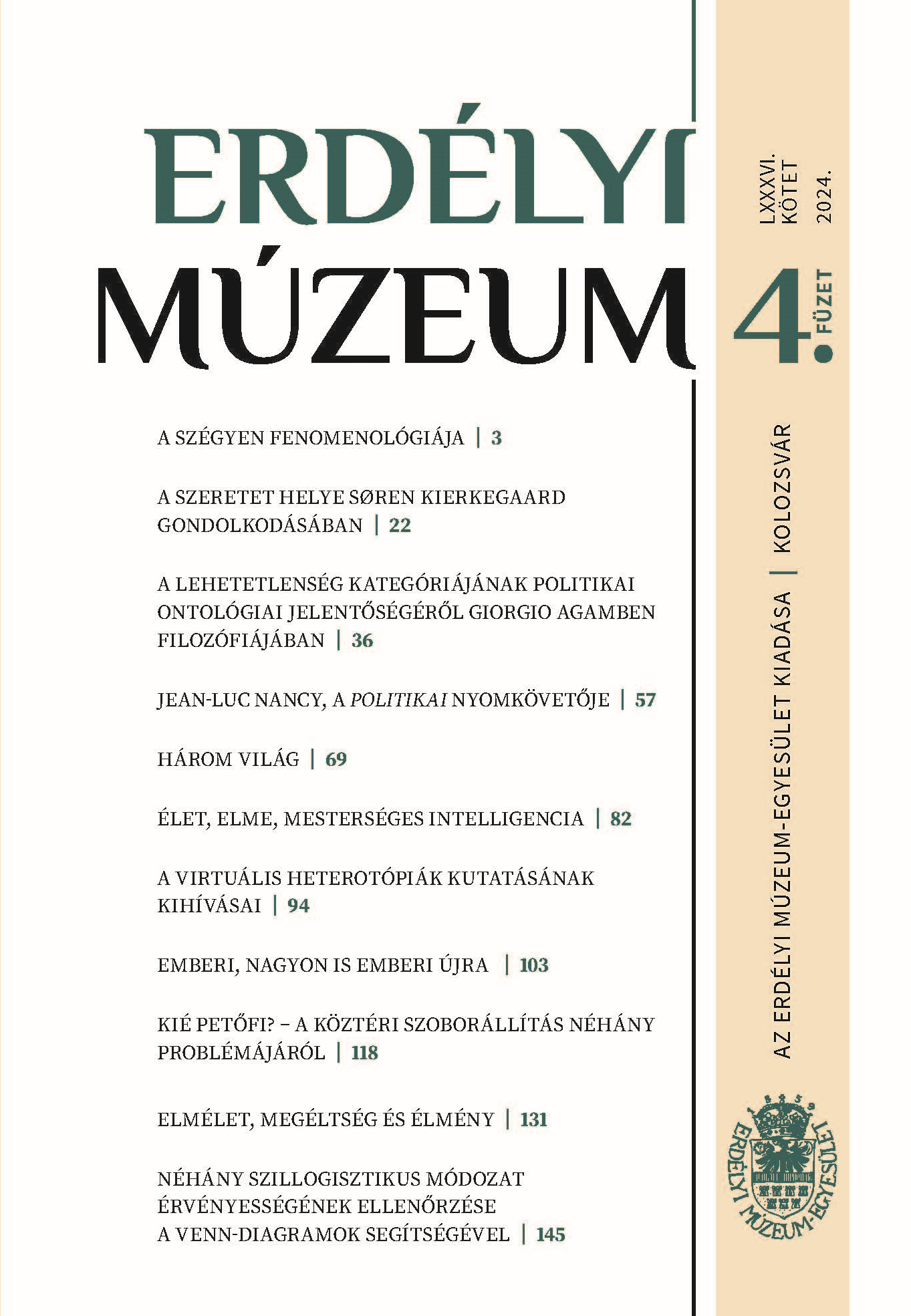
A lehetetlenség kategóriájának politikai ontológiai jelentőségéről Giorgio Agamben filozófiájában
On the Political and Ontological Significance of the Category of Impossibility in the Philosophy of Giorgio Agamben
Author(s): Zalán-György IlyésSubject(s): Epistemology, Ethics / Practical Philosophy, Ontology, Philosophy of History
Published by: Erdélyi Múzeum-Egyesület
Keywords: Giorgio Agamben; political ontology; the paradox of sovereignty; impotence; reconstruction
Summary/Abstract: The starting point for my thesis is the Agambenian idea that “[u]ntil a new and coherent ontology of potentiality […] has replaced the ontology founded on the primacy of actuality and its relation to potentiality, a political theory freed from the aporias of sovereignty remains unthinkable.” If today, almost thirty years after the writing of his major work Homo Sacer, we believe that Agamben’s statement is correct and that the task he has set for himself is worth undertaking, we must clarify how far the philosopher has gone in his conception of this political theory. To do so, however, we must first answer the question of whether he has succeeded in developing a ‚new and coherent’ ontology of potentiality that is fit for purpose and, if so, how this ontology works. Although for obvious reasons it is not possible to fully explore the logic of this ontology, we can highlight some of its more important elements in the hope of clarity. In my paper, I argue that the category of impossibility is of crucial importance in Agamben’s political ontology, since, in addition to allowing the category of possibility to be grasped in and as itself (and thus radically challenging the primacy of actuality), it provides a means for a radical rethinking of the event of actualization. As I note at the beginning of my essay, I have tried to keep Agamben’s actual purpose in mind while writing it, so in addition to the political and philosophical contextualization of my thesis, I also reflect on the aesthetic, ethical and political implications of the category of impossibility.
Journal: Erdélyi Múzeum
- Issue Year: LXXXVI/2024
- Issue No: 4
- Page Range: 36-56
- Page Count: 21
- Language: Hungarian
