
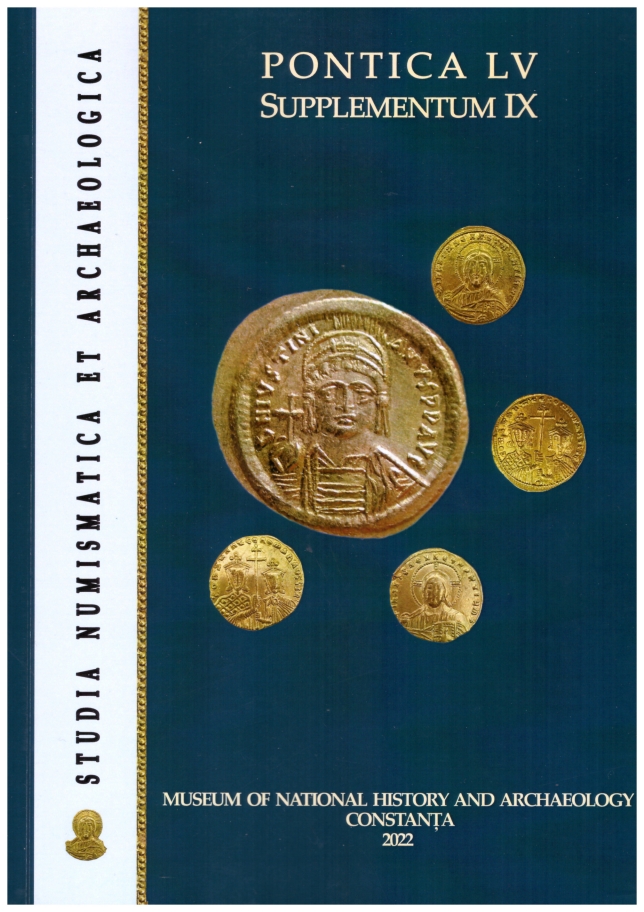
CONSIDERAȚII ASUPRA RELAŢIILOR ŢĂRII ROMÂNEŞTI CU CEL DE AL DOILEA ŢARAT BULGAR ÎN LUMINA
DESCOPERIRILOR MONETARE. A DOUA JUMĂTATE A SECOLULUI AL XIII-LEA – SFÂRŞITUL SECOLULUI AL XIV-LEA
CONSIDERATIONS ON THE RELATIONS OF WALLACHIA WITH THE SECOND BULGARIAN EMPIRE IN THE LIGHT OF MONETARY DISCOVERIES. THE SECOND HALF OF THE 13TH CENTURY – THE END OF THE 14TH CENTURY
Author(s): Ernest Oberländer-TârnoveanuSubject(s): History, Archaeology, Ancient World, Middle Ages, 13th to 14th Centuries
Published by: Muzeul de Istorie Națională și Arheologie Constanța
Keywords: hoards; Bulgarian medieval coins; the Second Bulgarian Tsardom; Principality of Wallachia;
Summary/Abstract: In this contribution dedicated to celebrate the scholarly activity of my dear friend and dear colleague, dr. Gabriel Custurea, one of the most prolific and innovative Romanian numismatists of the “new generation”, the author put under a throughout scrutiny the entire set of data, so far available, regarding the monetary finds of the rulers of the Second Bulgarian Tsardom, during the second half of the 13th to the end of 14th century, known on the Romanian territories, located between the Southern Carpathian range and the Lower Danube. This area will be organised during the 13th-14th century as an autonomous/independent state - the Principality of Wallachia. In the Romanian public museum’s collections, as well as in some private collections are kept several unedited hoards and single finds of mediaeval Bulgarian issues in silver or copper, or of their contemporary imitations. In the current Romanian numismatic literature, one can find quite a lot of references to finds of Bulgarian mediaeval coins, but most of them consist just in brief mentions, sometimes very confuse or even, wrong. So far, only few finds are, more or less, properly published, according to the contemporary numismatic standards and provided with decent quality illustrations.The author of this contribution has reanalysed the entire numismatic dossier regarding the finds of Bulgarian issues found in Wallachia, based on the most recent academic contributions regarding the evolution of coinage of this state, the works published by Vladimir Penčev (1990), Stojan Avdev (2007) and Konstantin Dočev (2003 and 2009). Thanks to these contributions it was performed an important and profound up-to-dating operation concerning the scholarly knowledge of the Bulgarian medieval coinage of 13th-14th century. Now a day, due to these valuable contributions, the scholars working on the Bulgarian mediaeval coinage could rely on a series of new attributions, dating’s, classifications and mints identifications. Unlike the first half of the 13th century, when Byzantine style billon anonymous issues dominated the Bulgarian coinage, during the later period and the 14th century, the coinage of this state was marked by a series of innovations, such as the generalisation of signed issues and the spread of large-scale silver coinage, especially after 1331. The first stage of the diffusion of the signed Bulgarian medieval coinage on the territory of Wallachia is documented by a few coin finds containing bronze issues from the second half of the 13th century. Broadly speaking, during the entire second half of the 13th and 14th century the presence of the Bulgarian bronze issues is very scarce attested in the areas located north of the Danube. The first issues belong to the reign of the Tsar Constantine Tych-Asen (1257-1277). Such finds of bronze stamena are known at Drobeta-Turnu Severin (Mehedinți County), in the area of the Iron Gates of the Danube and in the area of Ploiești (Prahova County), a region rich in salt deposits. After this moment, for almost three decades onward, until the reign of Theodore Svetoslav (1308-1322) there are not recorded finds of bronze coin of the Bulgarian rulers on the Wallachian territory. The only find of stamena of Theodore Svetoslav, so far, known in Wallachia came from Drobeta-Turnu Severin. Very few bronze coins from the reign of Michael Šišman, Ivan Aleksander, Ivan Šišman and Ivan Stratsimir are known, mostly in settlements near the Danube, such as: Coconi (Călărași County), Zimnicea (Teleorman County), Maglavit (Dolj County), Basarabi (Dolj County) and at Drobeta-Turnu Severin. Inland, only in the area of the city of Bucharest or nearby (Buftea, Mănești, Snagov Monastery, all in Ilfov County), there is an important concentration of finds of bronze coins, but actually, they are all imitative issues, crude style and fabric replicas of some Bulgarian prototypes from the second half of 14th century. The presence of these imitations in late 14th century or early 15th century hoards, located in South-Western Dobruja or North-Eastern Bulgaria, represents a major indication that they are later issues, quite likely struck by the Wallachian princes for their trans-Danubian possessions.The major compound of the 14 century Bulgarian monetary finds in Wallachia that consists of silver issues - aspra. Most of them belong to a large group, the so-called joint issues of the associated reign of Ivan Alexander and Michael Asen (1332-1355). In fact, recent researches have proven that such silver issues were also struck later, after the death of Michael Asen, during the joint reign of Ivan Aleksander with Ivan Šišman (1356- 1371), as well as during the first decades of John Šišman’s single reign (1371-cca. 1380). On the territory of Wallachia are mentioned several single finds of silver aspra of Ivan Aleksander and Michael Asen type, such as: Oltenița (Călărași County), Zimnicea, Alexandria, Lăceni (all in Teleorman County), Curtea de Argeș (Argeș County), Verbicioara (Dolj County), Drobeta-Turnu Severin, and Oprișor (all in Mehedinți County). In the Romanian numismatic literature one can find data regarding several hoards containing silver issues of Ivan Aleksander and Michael Asen type, such as: Dichiseni (Călărași County), the hoard found on the Danube’s bank, at the kilometer 346, Balaciu (Ialomița County), Bucharest (nearby), Scrioaștea, Balta Sărată (all in Teleorman County), Bascov, Câmpulung Muscel (all in Argeș County), of unknown finding place in southern Oltenia, Lazu (all in Dolj County), Slatina, Teiuș (all in Olt County), Drobeta- Turnu Severin, Jiana Mare (all in Mehedinți County) and the so-called ”Oltenia I” hoard, found in 1907, in an unknown place in that region. The hoards of Dichiseni, Slatina and of unknown finding place in southern Oltenia in spite of being concealed during the period 1356-1367, consist entirely of Bulgarian silver aspra of Ivan Aleksander and Michael Asen type, most of them issued before 1356. The other mentioned hoards consist of silver coins of Ivan Aleksander and Michael Asen type coins mixed with local ones, Wallachian issues, as well as foreign silver issues, such as aspra of Ivan Šišman, the ruler of the Tsardom of Tarnovo, Ivan Stratsimir, the ruler of the Tsardom of Vidin, Serbian, Venetian, Hungarian and early Ottoman coins. In sharp contrast with the high frequency and the large volume of the finds of silver issues of Ivan Aleksander and Michael Asen type, struck during the period 1337-1367, the issues of the same type, bearing the name of Ivan Šišman or the subsequent issues of this ruler (1371-1393) are extremely scarce among the finds found on the territory of Wallachia. In this respect, only the hoards from Păcuiul lui Soare, the bank of the Danube at kilometre 349 (all in Constanța County), Balta Sărată and Drobeta-Turnu Severin that contain a few number of aspra of Ivan Šišman can be mentioned. In spite of the marked reduction of the presence of the silver coins struck by the last ruler of the Tsardom of Turnovo in the structure of the monetary finds from Wallachia, dated after 1371, the role played by the Bulgarian coinage remains quite strong thanks to the influx of the issues of Ivan Stratsimir, the ruler of the Tsardom of Vidin. In the Romanian numismatic literature, one can find many mentions of such coins, spread all across the Wallachian territory, such as: Dridu-Metereze (Ilfov County), Coconi (Călărași County), Guruieni (Teleorman County), Târgoviște (Dâmbovița County), Curtea de Argeș, Câmpulung Muscel (all in Argeș County), Portărești, Basarabi (all in Dolj County), Drobeta-Turnu Severin, Gruia (all in Mehedinți County). The silver aspra of Ivan Stratsimir are often found in the Wallachian hoards concealed after 1370, always associated with Wallachian and foreign coins, such as: Maraloiu II hoard (Brăila County), Balaciu, Vlad Țepeș (all in Ialomiţa County), Târgșorul Vechi (Prahova County), nearby Bucharest, Scrioaştea, Balta Sărată (all in Teleorman County), Bascov, Câmpulung Muscel (all in Argeș County), Târgoviște (Dâmbovița County), Brebeni, Balș (all in Olt), Gogoșu, Drobeta-Turnu Severin/1915 and ante 1987, Bistrița and Păsărani (all in Mehedinți County). The pattern of the Bulgarian monetary diffusion toward the Wallachian territory presents a profound change during the second half of the 13th and the 14th century. The base billon or bronze issues, which represented the main circulatory means during the 12th and early 13th century, became very scares, their use seeming to be restricted, mostly, in the areas near of the Danube, because of the daily or more regular contacts between the inhabitants of both banks of the river. A special situation is shown by the quite numerous finds of Bulgarian bronze coins found at Turnu-Severin, which seems to mark not only a more advanced economic and social organisation of the population established inside the remains of the Roman fortifications, revealing an proto-urban life style, having strong connexions with the Balkan world. Based on the witness of the written historical sources, as well as by the presence of many petty coins, one could suppose that the bridgehead from Severin was, from time-to-time, under a form of Bulgarian military and political control, in spite of the Hungarian claims. During the 1330’s and the 1340’s the pattern of monetary circulation in Wallachia move more and more farther from the traditional Byzantine system, based on billon and gold issues to a Central European circulatory model, based on silver. The beginnings of the local coinage during the second half of the 1360’s pushed even more dramatically the aspect of the monetary circulation in Wallachia to the Central European pattern. The make-up of the monetary finds containing Bulgarian silver issues suggests a massive influx of the aspra of Ivan Aleksander and Michael Asen type into the Wallachian territories during 1332-1356 and a quite drastic reduction during the period from 1356 to 1367. In sharp contrast with the situation revealed during the previous decades, the silver issues of Ivan Shishman, the ruler of the Tsardom of Turnovo, are extremely scarcely represented in the hoards, and, virtually absent among the single finds in Wallachia. By contrast, the local finds, both hoards and single finds, does contain a very significant proportion of aspra struck for Ivan Stratsimir, the ruler of Vidin. However, except the hoard of Bascov, which contains an important parcel of heavy weight issues, supposed to have been produced during his first reign (1352/56-1369), all the finds available for scholarly recording consist of issues struck during the second reign of this ruler (1370- 1396). During the 1330’s and 1340’s the Bulgarian Tsardom and Wallachia were allied, an alliance sealed also by a dynastic marriage between Ivan Aleksander and Theodora, the daughter of the Wallachian Prince, Ioan Basarab. The large amount of Bulgarian silver coins, both struck in the mint of Turnovo or Vidin, found in Wallachia are the result of a thriving bilateral trade, based on the export of the main Wallachian stuff: salt, cattle, salted fishes, hides, furs and other agricultural products, as well as from the taxation of the intermediate commerce. However, the repudiation of Theodora in 1348, the change of the succession order by removing Ivan Stratsimir to the benefit of Ivan Shishman, as well as the use of Ottoman forces as a support against the neighbouring states lead to an increasing hostility between Wallachia and the Tsardom of Turnovo, and a closer cooperation with Ivan Stratsimir and the Tsardom of Vidin. On the same line of anti-Turnovo and pro-Vidin policy sustained by the Wallachian princes was also the rapprochement to Dobrotitsa, the Byzantine Despot ruling southern Dobrudja and the Black Sea coast from Kaliakra to Mesembria. The investigations made on the circulation of the Bulgarian medieval silver coins in Wallachia, during the second half of 14th century, put clearly in evidence the strong impact of the evolution of the political relationships between these countries on the diffusion of the issues struck by the last rulers of the Tsardom of Turnovo and Vidin in the territories located north of the Danube.
Journal: Pontica
- Issue Year: 2022
- Issue No: 55 Supp IX
- Page Range: 207-257
- Page Count: 51
- Language: Romanian
