
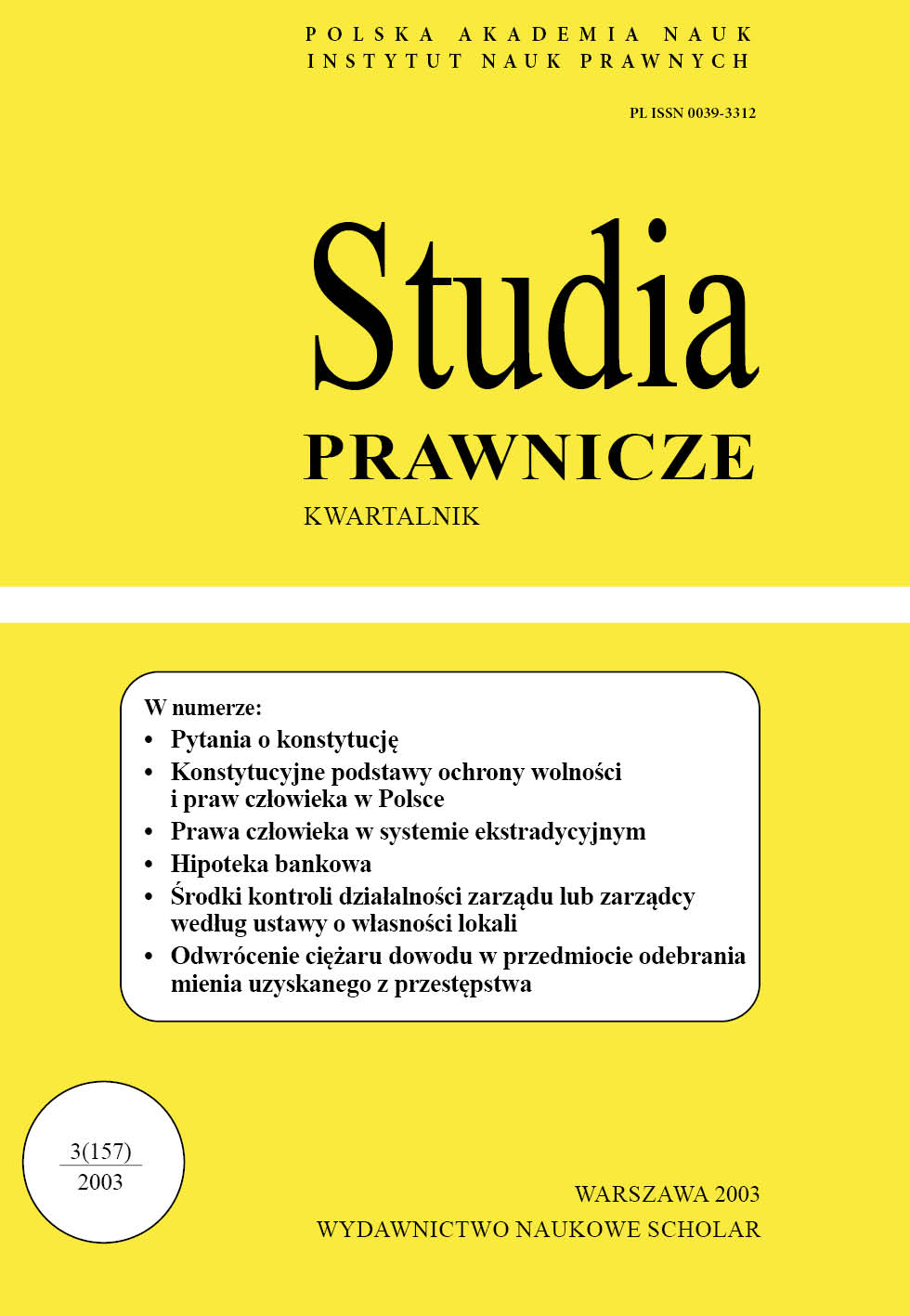
Środki kontroli działalności zarządu lub zarządcy według ustawy o własności lokali
Measures to control the activities of a management board or manager according to the Apartment Ownership Act
Author(s): Joanna KozińskaSubject(s): Law, Constitution, Jurisprudence
Published by: Instytut Nauk Prawnych PAN
Keywords: control; menagement; premises; housing community; board member; responsibility; injury; co-operative
Summary/Abstract: If an agreement on the entrustment of the management of the joint property, concluded in the form of a notarial deed, does not contain any provisions to the contrary, the provisions of the Civil Code shall apply, in particular the provision of Article 208, which gives each of the owners who do not manage the joint property the right to demand an account of the management within appropriate periods. This general provision should be interpreted broadly, assuming that it is not just a matter of presenting a balance sheet, but of submitting a report with comprehensive information and explanations.Where management is entrusted to certain apartment owners or to a third party through a property management agreement, the application of the provision of Article 201 sentence 2 of the Civil Code seems excluded. After all, apartment owner who does not manage the joint property cannot request a court authorisation to carry out the activities that the manager has been contractually entrusted with. Indeed, the agreement to entrust the management to a designated manager excludes the rights of the apartment owners to manage according to statutory rules.The only correct form of fulfilment by the management board or manager of the obligation specified in Article 30(1)(2) of the Apartment Ownership Act is the delivery of the activity report to each owner within a reasonable time allowing them to become acquainted with it before the annual meeting of all apartment owners, the subject of which will be the evaluation of the work of the management board or manager and the granting of a discharge. This is because it is difficult for an owner who is deprived of information to determine whether the management board or manager is performing its duties well. In addition, it will be necessary to present a report at the annual owners' meeting and provide explanations in this regard and resolve any concerns.Approval of the management board’s report is a statement of the veracity of the data contained therein, but does not include an assessment of the management board's activities. Indeed, this assessment is reflected in the discharge resolution. Therefore, the approval of the report does not preclude the adoption of a resolution not to discharge.No provision of the Apartment Ownership Act stipulates that failure to discharge the management board is tantamount to its dismissal. This means that it is up to the apartment owners to decide on the future of the management board or manager in each case. Exceptionally, they may keep the existing management board or manager in place if they consider that the negative assessment relates only to certain activities and the management board or manager undertakes to take steps to improve operations in the future.Pursuant to Article 25 of the Apartment Ownership Act, only the owner, and not the management board, may challenge such a resolution in court on the grounds that it does not comply with the law. It cannot be ruled out that all owners will agree on the removal of the management board and no one will challenge such a resolution within the six-week period provided for in Article 25(1a) of the Apartment Ownership Act. In view of the fact that the term indicated is a final date term and the legislator has adopted the concept of relative nullity (revocability) of such a resolution, the resolution will be validated even if it is contrary to the law.The appointment of an administrative receiver is made in non-trial proceedings, as this is by the very nature of this type of court activity.The owner's right of inspection is matched by a duty on the part of the management board or manager to enable them to exercise this right, which entails a claim for an explanation or access to documents or the community's books. However, the legislator did not provide for any regulation in this regard. In order to resolve this issue, one may refer to the model regulation contained in the provision of Article 212 CCC, concerning the exercise of the right of control in a limited liability company.An action [on behalf of the housing community for damages against the members of the management board or manager] may be brought by all owners of the apartments forming the housing community. They may also authorise an attorney to appear before the court on their behalf. Finally, such an action may be brought on behalf of the community by a newly elected management board or a new manager against former management board or a former manager.
Journal: Studia Prawnicze
- Issue Year: 157/2003
- Issue No: 3
- Page Range: 121-141
- Page Count: 21
- Language: Polish
