
Swoje = obce / obce = swoje? Śpiew jako wędrowiec, czyli o transferze, granicach, doświadczaniu i tożsamości z polsko-bułgarskiej perspektywy
Familiar = Unfamiliar / Unfamiliar = Familiar? Singing as a Wandering Traveller, or on Transfer, Limits, Experiencing, and Identity from the Polish-Bulgarian Perspective
Author(s): Weronika Grozdew-KołacińskaSubject(s): Fine Arts / Performing Arts
Published by: Instytut Sztuki Polskiej Akademii Nauk
Keywords: singing;anthropology;culture;Poland;Bulgaria
Summary/Abstract: “Whose is this song?” – director Adela Peewa asks her interlocutors and herself in a tragic comic document bearing the same title. The song was “here” and is “ours” for always, but on a geographical map these numerous instances of “here” are separated by several hundred kilometres. On a mental map they might be even more distant, although, after all, they are close since they are linked not only by that one melody but by an entire cultural plexus, albeit frayed by variously defined borders. The song roams while assuming increasingly new voices singing their stories – different or identical. Polish Christmas carols are part of the repertoire of Bulgarian Catholics from the region of Plovdiv and Svishtov, and mazurkas and polkas brought over by Polish exiles after the Spring of Nations and the January Uprising constituted an important part of the repertoire of the first Bulgarian orchestra performing in “the European spirit”. Poles also participated in the Bulgarian nineteenth-century school system (music and choral studies). “Unfamiliar” rather rapidly becomes “familiar”, but even quicker appears to be the collective oblivion of this process, while seeking its source, assuming that such a feat is possible, can prove to be inconvenient. Today, the song travels with even greater impetus, carried by a live human voice and transferred by a virtual Internet medium. The Balkan song has for long enjoyed the particular esteem of Polish (and not only) researchers and practicians of traditional and folk singing alike. A look taken at the wanderings and domestication of a song / singing through the prism of the categories of “multi-strata identity” and “transcultural medium” permits a fairer description of examined phenomena, without ascribing superiority to one of the elements of the musical-cultural jigsaw puzzle. In this case the biculturalism of the researcher, which I share, is an added value, although not always one that makes it easy to capture methodological distance, especially when self-reflection pertaining to undertaken research problems is at stake. The author considers the above-mentioned problems and issues by referring to her personal research and cultural experiences, and, additionally, by speaking of reflections and works by other authors dealing with, i.a. such categories as: multicultural identity, cultural transfer, borderline quality, wandering, itinerant repertoire or the familiar-unfamiliar antinomy. The cohesive motif is the song/singing conceived as a factor of self-reference, interpersonal communication, and telling “small” narratives.
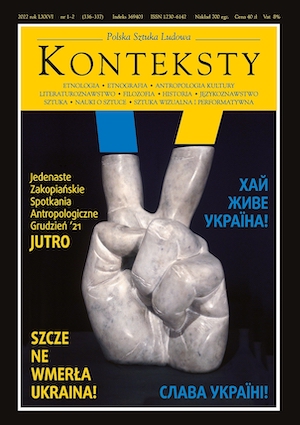
Journal: Konteksty
- Issue Year: 336/2022
- Issue No: 1-2
- Page Range: 388-396
- Page Count: 8
- Language: Polish
