
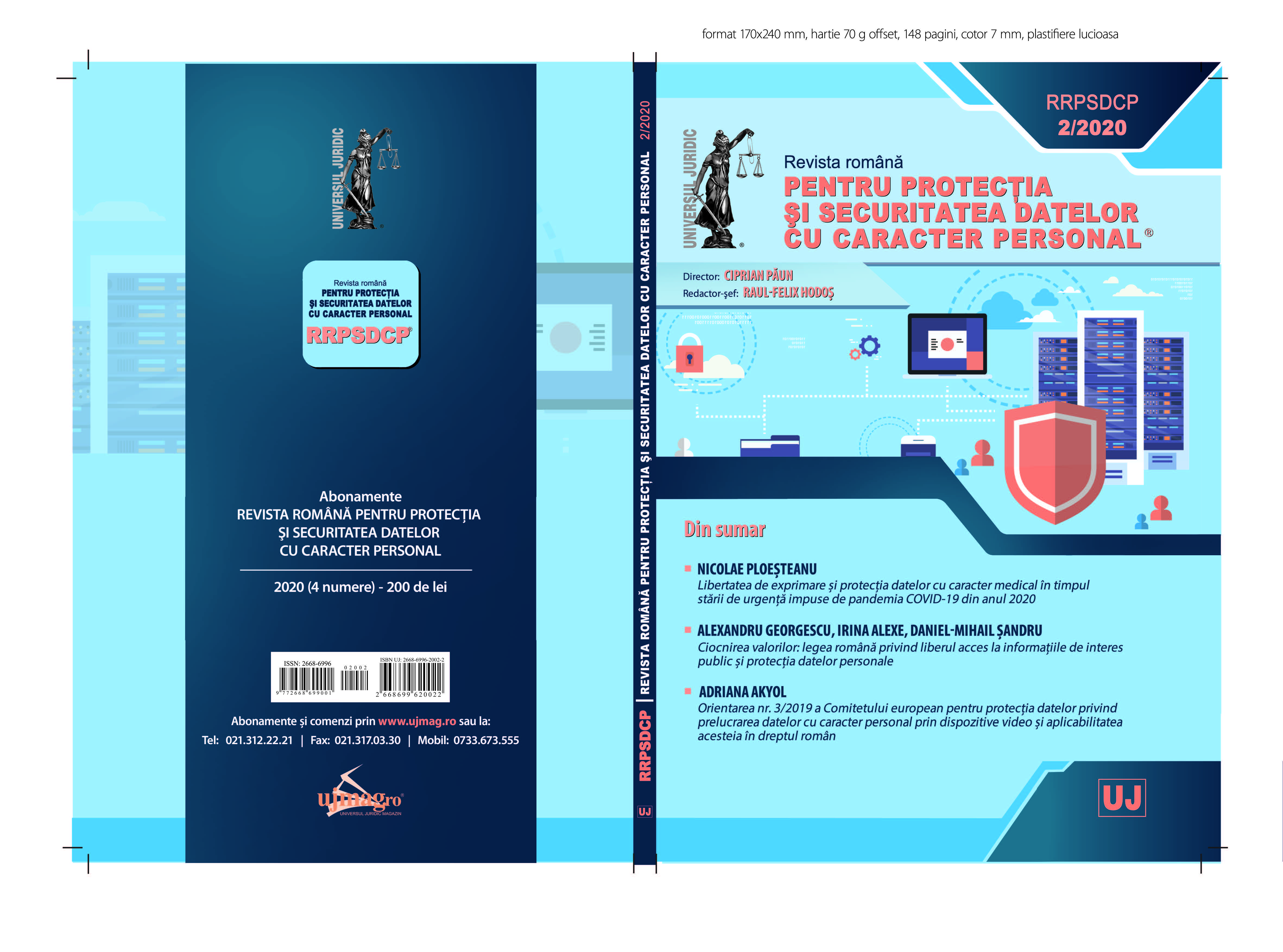
Orientarea nr. 3/2019 a Comitetului european pentru protecţia datelor privind prelucrarea datelor cu caracter personal prin dispozitive video şi aplicabilitatea acesteia în dreptul român
EDPB Guidelines 3/2019 on processing of personal data through video devices and its applicability in Romanian law
Author(s): Adriana AkyolSubject(s): Law, Constitution, Jurisprudence, Civil Law
Published by: Universul Juridic
Keywords: personal data processing; GDPR; video surveillance;
Summary/Abstract: The enactment of the Regulation (EU) 2016/679 (GDPR) has determined amendments to the legal regime of the personal data processing under the EU Directive 95/46/EC (repealed by the GDPR), including those performed through video surveillance devices. Personal data processings through video surveillance devices are frequently encountered in practice and employ technologies with an accelerated development and an increasingly convenient cost, thus having a significant impact on the data subjects’ interests, rights and liberties. In view to ensure the coherent application of the GDPR’s requrements in this field by its stakeholders, the European Data Protection Board has recently issued the Guideline No. 3/2019 on processing the personal data through video devices (Guideline No. 3/2019). The said guideline is also applicable in the Romanian data protection law (being rounded of by the Romanian legislation enacted for the application of GDPR in certain fields where enacting specific national legal requirements is permitted by GDPR), and must become a working and refference instrument for all GDPR’s stakeholders, including for the practice of the Romanian Data Protection Authority and the case law of the Romanian courts. This article presents the main provisions of the Guideline No. 3/2019 and its applicability in the Romanian law in force. In the analysis dedicated to the Romanian law, there are presented particular aspects of the specific national legal provisions in the field and there are offered relevant examples from the practice of the Romanian Data Protection Authority and from the case law of the courts, developed under GDPR, after this regulation’s entry into force.
Journal: Revista română pentru protecţia şi securitatea datelor cu caracter personal
- Issue Year: 2020
- Issue No: 02
- Page Range: 34-54
- Page Count: 21
- Language: Romanian
- Content File-PDF
