
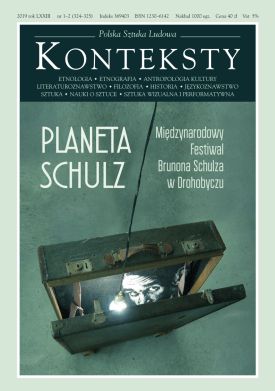
Kiedy miejsca znikają za zasłoną języka mitu: bujna gwałtowność wspomnień z dzieciństwa w „Sklepach cynamonowych” Brunona Schulza
When Places Disappear behind Myth’s Language: the Lush Rampancy of Childhood Memory in Bruno Schulz’s “The Cinnamon Shops”
Author(s): Jana WaldhörSubject(s): Language and Literature Studies
Published by: Instytut Sztuki Polskiej Akademii Nauk
Keywords: Bruno Schulz;literature
Summary/Abstract: The paper tries to apply Walter Benjamin’s concept of memory and history, formulated in Passagen-Werk, Berliner Chronik and Berliner Kindheit um 1900, as an instrument to Bruno Schulz’s prose volume The Cinnamon Shops. Not only are there only three days in between the date of birth of these two authors, but also both became victims of the Holocaust. In spite of one being a ‘Western’ and the other being an ‘Eastern Jew’, their approach to childhood memory and their working with and on it resembles, as will be examined.Based on Walter Benjamin’s idea of history and memory, which is strongly connected to the paradigm of spatiality, the autobiographical sketches and snapshots in Bruno Schulz’s prose volume The Cinnamon Shops will be examined more closely and a topography of childhood will be revealed. By doing so, terms such as Tiefe der Erfahrung, Archäologie des Erinnerns and raumgewordene Vergangenheit, which Walter Benjamin formulated in several papers, will be revealed in Bruno Schulz’s approach to his childhood memory. The consistency of the authors’ approach with and on their childhood memories will be illustrated with two examples.Subsequently, Drohobycz, which is not only the place of Bruno Schulz’s childhood, but also operates as a place of a triple bond, will be examined in more detail on the basis of several passages in The Cinnamon Shops. Including relevant literature, such as Gaston Bachelard’s La poétique de l’espace and the use of terms such as parergon (Jacques Derrida, La vérité en peinture) and simulacrum (Jean Baudrillard, Simulacres et Simulation), Bruno Schulz’s view at the spaces of his childhood is to be substantiated. It soon becomes apparent that Bruno Schulz’s Drohobycz only exists under the danger of disappearance for two reasons: on the one hand due to the collapse of the Austro-Hungarian Monarchy, and on the other hand due to the onset of industrialization. Finally, it is Bruno Schulz’s language of myth, which, like the lush gardens in his memories, forces its way into the Galicia of his childhood and gradually makes it vanish beneath it.
Journal: Konteksty
- Issue Year: 324/2019
- Issue No: 1-2
- Page Range: 275-282
- Page Count: 8
- Language: Polish
- Content File-PDF
