
FINANCIAL GLOBALIZATION AND ECONOMIC DYNAMICS
FINANCIAL GLOBALIZATION AND ECONOMIC DYNAMICS
Author(s): Florin Cristian CiurlăuSubject(s): Financial Markets, Globalization
Published by: Addleton Academic Publishers
Keywords: financial markets; banking crisis; systemic risk;
Summary/Abstract: It is more than obvious that financial globalization has entailed dysfunction or distortions, even accidents, disparate times, whose recurring frequency, in recent times, has become downright alarming. No matter how they are named, the elements or components in financial and banking are ubiquitous. It is difficult, of course, to strictly delimit rigorous financial phenomena or banking in all those general economic imbalances, including as a whole more or less serious ones, which runs in the world today, thanks to interdependences, material and nominal flows, real and fictional, the causes that were initiated and quality of those affected in one way or another. These are the market crisis, as an expression of price instability on global financial markets and the lack of liquidity, which may manifest itself in unexpected way. The most violent crises were triggered on economic asset markets. All these really show the existence of risk sources liable to propagate throughout the financial systems (sudden and unexpected increases in interest rates, sharp decreases of asset prices, and the lack of liquidity of restricted markets). Banking crises are causing mistrust towards banks, in general, a fact which may cause panic, manifested in all the developed industrial states. Banking crises are more punctual, affecting institutions in the field of utmost importance. The August 1972 crisis borrowing from third world states cannot be ignored. Authorities were able to prevent the onset of a monetary catastrophe, but nevertheless, the crises of the kind mentioned led to the rise in the cost of financial intermediation, thus generating a climate of insecurity such as to alter the quality of specific financial information systems. In addition, it has appeared, and has been emphasized the danger of the crisis of payments – considered the most serious type of accident or as a result of an internal dysfunction within a central system, either as a repercussion of a banking crisis. Emphasizing financial liberalization in developing states, including those engaged in transforming their capitalist economic systems, but not only, has sharpened the issue of economic and financial disturbances, especially events of inefficiency, of counterperformance, likely to raise many questions on the justification of non-selective promotion of market fundamentalism, especially in a globalized economy. We also keep in mind that monetary phenomena are flanked by natural visible various types of interests, on particularly developed sophisticated channels. We start from the fact that globalisation is a process characteristic of the contemporary world and that the financial-banking system reaction to globalization is one specific and particularly complex.
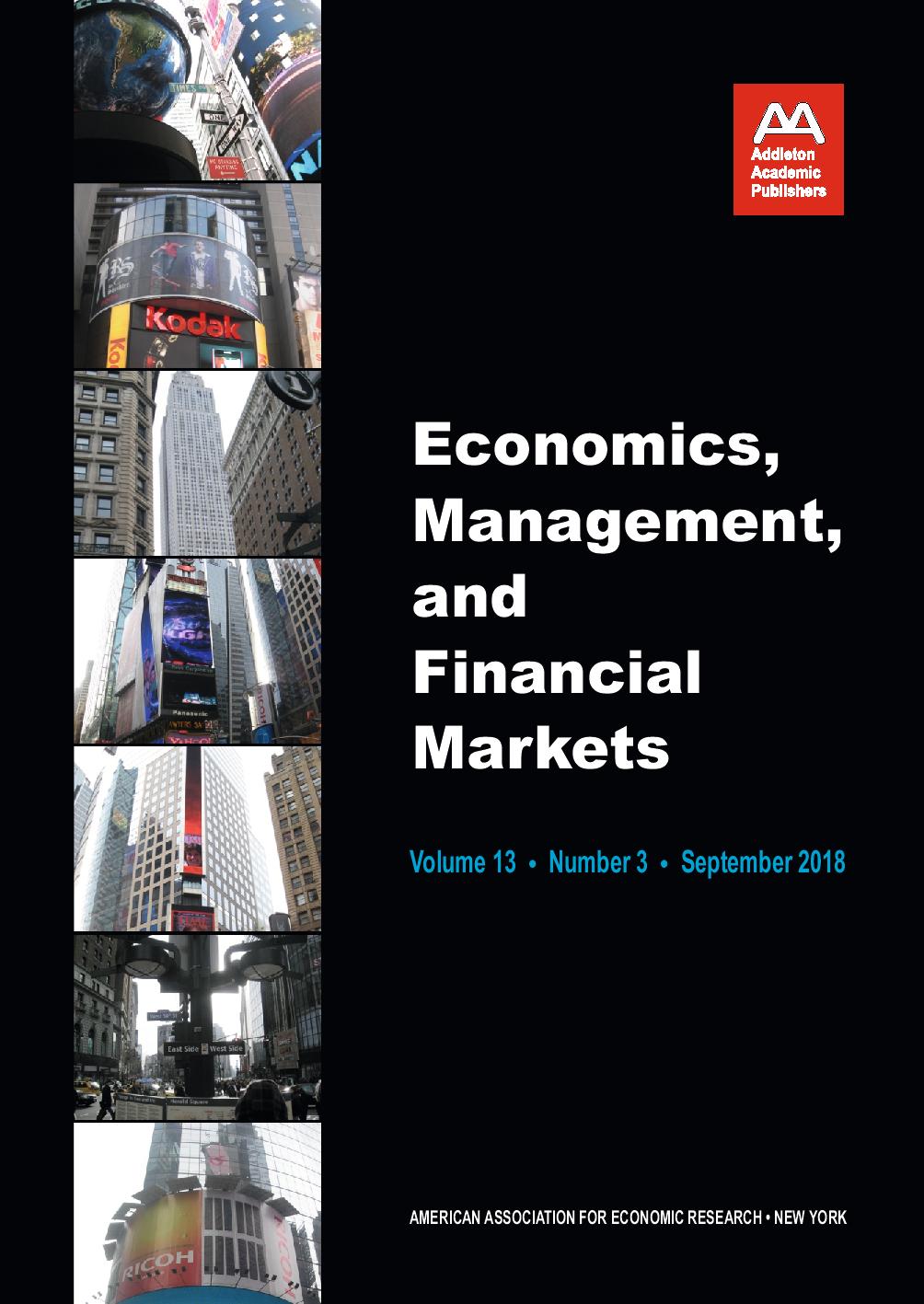
Journal: Economics, Management, and Financial Markets
- Issue Year: 13/2018
- Issue No: 3
- Page Range: 340-350
- Page Count: 11
- Language: English
- Content File-PDF
