
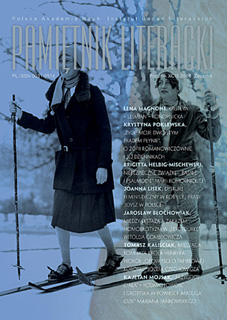
Między ekstazą a zakazem. Homoerotyzm w „Ferdydurke” Witolda Gombrowicza
Between an Ecstasy and a Ban. Homoerotism in Witold Gombrowicz’s “Ferdydurke”
Author(s): Jarosław BłochowiakSubject(s): Literary Texts
Published by: Instytut Badań Literackich Polskiej Akademii Nauk
Keywords: Witold Gombrowicz; Witold Gombrowicz’s “Ferdydurke”; Witold Gombrowicz’s “Pornografia”;
Summary/Abstract: The subject in Gombrowicz’s texts “streches” between the experience of ecstasy, the center of which is the beauty of the young boy, and the ban encompassing this experience. Upon gaining admiration, he concurrently ceases it since such experience enters into the excluded, unknown and inexpressible. The model of such reaction in “Pornografia” is the mass scene: delighted at the boy’s presence, the narrator suddenly “takes his ecstasy off”. Equivalents of this scene can be found in Gombrowicz’s whole work. The author of the paper focuses on two such realizations which concentrate on the characters of Ferdydurke”: Kopyrda and a farmhand (Walek). In Gombrowicz’s text in question, the homoerotic spell proves on the one hand, to be an ecstatic experience, and on the other hand it is seen as an inexpressible strangeness which breaks the established systems of meanings. Sexual “distinctness” marks the novel’s world with a promise of integration and complete cohesion, and simultaneously leads to disintegration.
Journal: Pamiętnik Literacki. Czasopismo kwartalne poświęcone historii i krytyce literatury polskiej
- Issue Year: 2008
- Issue No: 4
- Page Range: 79-95
- Page Count: 17
- Language: Polish
