
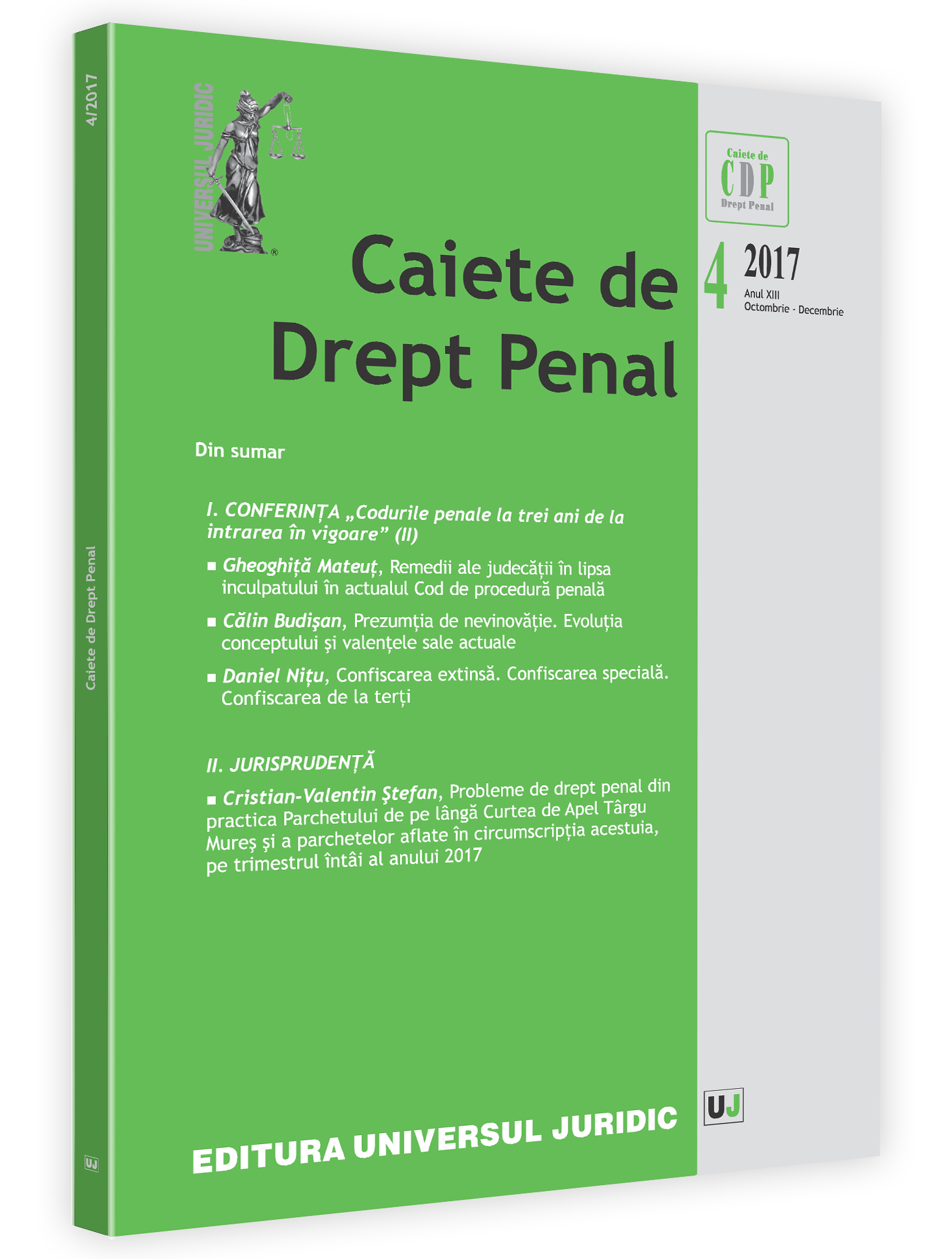
Remedii ale judecăţii în lipsa inculpatului în actualul Cod de procedură penală
Remedies for trial in absentia under the current
Criminal Code of Procedure
Author(s): Gheorghiţă MateuţSubject(s): Law, Constitution, Jurisprudence
Published by: Universul Juridic
Keywords: fair trial; trial in absentia; notification; main subjects; parties; reopening of the criminal trial; European Court of Human Rights;
Summary/Abstract: This study is a transcription of the presentation the author gave at the conference entitled „Three years from the entry into force of the new Criminal Codes”, which was organised in Cluj-Napoca, in March 2017, by the Babeș-Bolyai University Faculty of Law in Cluj. As a general rule, it is shown that a fair criminal trial must guarantee, among other things, that the accused will be present during trial and will be capable of following and understanding every part of the debates. Therefore, the author suggests that the so-called principle of personal appearance of the parties (especially of the accused) in front of the court should be acknowledged, next to the leading principles mentioned in Articles 2-12 of the Criminal code of procedure. Currently, the rule provided in the legal texts does not have the same strength for all parties, as there are some disparities between different subjects and the parties, particularly regarding the accused, who faces an atypical situation. The fundamental right of the accused to be present at trial is not an absolute one but, rather, is acknowledged as a relative right and, thus, may be waived under strict conditions and with certain guarantees. From a different standpoint, the state’s obligation to guarantee the accused’s right to be present in the courtroom is an essential element of a fair criminal trial, which also includes the guarantee of the right of a person tried in absentia `to be retried in his/her presence`. This is why the refusal to reopen a trial which took place in the absence of the accused was rightfully considered `denial of justice`, which is the equivalent of the concept of a procedure `manifestly against` the principle of fair trial, as it also results from the case-law of the European Court of Human Rights. The study also analyses the diverse situations which can determine the accused not to be present in front of the court and the way different legal systems, common-law and continental (Belgian, Italian, Spanish, French, Luxembourg, German, Russian), deal with these. The position of the European Court of Human Rights regarding this matter is also carefully examined, as the European court does not, as a rule, prevent trials in absentia. However, these procedures are accepted by the Court, as long as several strict conditions are met on a case-by-case basis. Following this presentation, the analyses shifts focus on Romanian legislation, as the author thoroughly identifies the faults and deficiencies of the applicable legal provisions, regarding both the notification and the presence of the accused, and the possibility of the reopening of the criminal trial in situations in which the trial took place in the absence of the accused. Finally, the last sections are dedicated to conclusions, as the author corroborates the legislation of evolved systems together with the conclusions of the European court in the most relevant decisions on this matter, while trying to bring some improvements to the Romanian criminal procedure law.
Journal: Caiete de drept penal
- Issue Year: 2017
- Issue No: 04
- Page Range: 11-26
- Page Count: 16
- Language: Romanian
- Content File-PDF
