
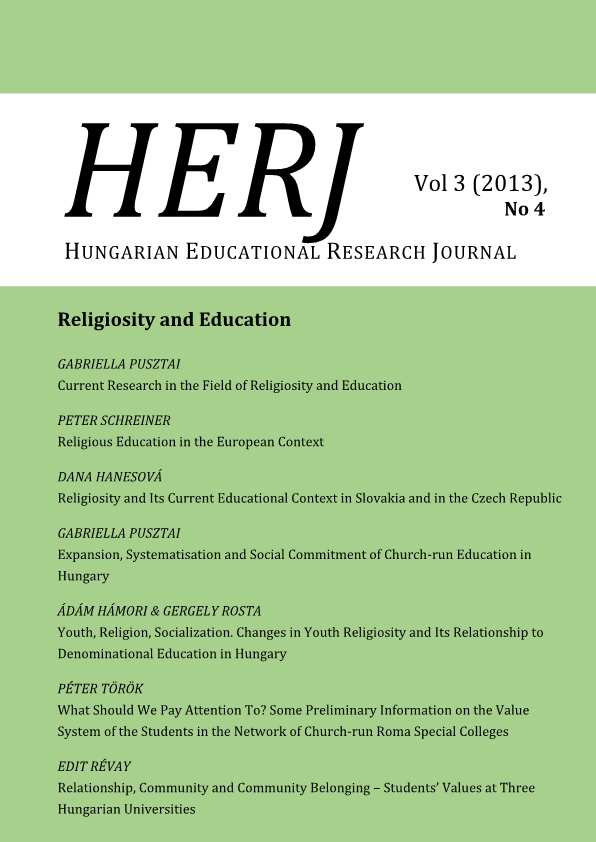
Relationship, Community and Community Belonging – Students’ Values At Three Hungarian Universities
Relationship, Community and Community Belonging – Students’ Values At Three Hungarian Universities
Author(s): Edit RévaySubject(s): Education
Published by: Hungarian Educational Research Association (HERA)
Summary/Abstract: Our main research questions were the following. What attracts students to denominational universities and colleges? What do they hope to achieve there? What they think they cannot receive at public higher education or at other kinds of non-state universities or colleges? Did the universities meet their expectations? Is there any specific characteristic of denominational higher education? Is it made explicit and if yes, how? How does it manifest in the institutional context? Does it manifests in admission procedures, in the ways professors or other staff members are recruited, in the expectations concerning students, professors and other employees, or in the teaching and leisure-time activities? Is there any difference between public and denominational higher educational institutions, and if yes, what kind of difference is it in terms of teaching, student life, and the norms and values there? Is there any institutional intention stated to enact any particular values? Is there any difference in terms of social background, lifestyles, and values between public and denominational university students? What do students really expect from denominational universities? Why do they choose denominational universities or colleges over public universities or colleges? Do religiousness and denomination have a special importance in their choice? Why non-relegious students choose denominational institutions?
Journal: HERJ Hungarian Educational Research Journal
- Issue Year: 3/2013
- Issue No: 4
- Page Range: 74-86
- Page Count: 15
- Language: English
