
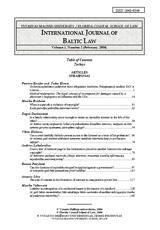
Ar galima drausti alkoholio reklamą visuomenės informavimo priemonėse?
Compatibility of the Prohibition of Alcohol Advertisement by Means of Public Information With the Constitutional Rights of Free Speech and Free ...
Author(s): Indrė PreibienėSubject(s): Law, Constitution, Jurisprudence
Published by: Florida Coastal School of Law and Vytautas Magnus University School of Law
Keywords: Compatibility; Prohibition; Alcohol; Advertisement; Public; Information; Constitutional; Rights; Free Speech; Free Economic Activities
Summary/Abstract: The issue of the article is whether prohibition of advertisement of alcohol is compatible with freedom of speech and right of free economic self-expression, which are protected by The Constitution of The Republic of Lithuania. This issue is extremely important in Lithuania, as there is a Law on Control of Alcohol, passed by Parliament, which prohibits advertisement of alcohol and alcohol beverages by means of public information. Moreover, The Constitutional Court of The Republic of Lithuania found that such Law does not conflict with the above-mentioned constitutionally protected rights. Nevertheless, there were various opinions concerning the decision of the Court among Lithuanian citizens, which led to a retrial of the question. In order to answer the question of compatibility of the prohibition of alcohol advertisement by means of public information with the constitutional rights of free speech and free economic activities, there were several theories in favor of the prohibition and against the prohibition of alcohol advertisement provided. The most rational theory was selected to be a theory of liberal truthfullness, which is the theory that The Supreme Court of The US applies in its decisions of similar kind. Having applied the US Supreme Court’s four-step approach of constitutional scrutiny of laws, which limit freedom of commercial speech to the Lithuanian situation we realized that the decision of The Lithuanian Constitutional Court was not based on a full-scale analysis. The arguments of the Court were insufficient to prove that the Law was proportionate to its goals, which the state had intended to reach. There was no evidence that the prohibition of dvertisement had led to a decrease of alcohol consumption in the state. The US precedent taught us to search for alternative ways of reduction of alcohol consumption, which would not violate constitutional freedoms of speech and economic behaviour. (...)
Journal: International Journal of Baltic Law
- Issue Year: 2004
- Issue No: 3
- Page Range: 154-170
- Page Count: 17
- Language: Lithuanian
