
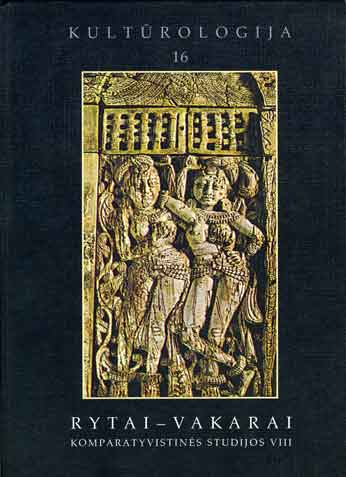
Senovės Indijos istoriografija
Historiography Of Ancient India
Author(s): Jolita ZabarskaitėSubject(s): Cultural Essay, Political Essay, Societal Essay
Published by: Lietuvos kultūros tyrimų
Keywords: ancient India; historiography of India; Indian epigraphy; historical Guptas evidences
Summary/Abstract: Since year 2000 the ancient and early middle age Indian historical research is brought to life by rethinking through ancient Indian history and its sources. The present research work from multidisciplinary integral standpoint is designated to reconsider historiography of ancient India in the instance of the history of the Imperial Guptas. Widely explored the era of Imperial Guptas is traditionally considered as the Golden Times of India, which will allow us to have a whole wide view on a strategy that has been used while writing history in ancient times. Historiographical Guptas sources, etc epigraphic records, coins and literatures are the basic and single evidences for reconstructing political and cultural history of the Imperial Guptas. The epigraphic records are the most significant out of all, because every aspect of the life, culture and activities of the Indians are reflected in inscriptions. How ever, while reconsidering the methods and techniques in studying the inscriptions or other literary evidences, we must take notice of the authors of the historical works as well as early medieval inscriptions. Cause in the context of early investigation of researchers we have established the fact that these authors were greatly influenced by the contemporary ideas of history and the methods of interpretation of the time. Unlike historians, who are reading these sources separate from the context or other evidences, we have tried to read the meaning of these inscriptions with their relation between their text and every component of its background. Cause in the end, only research based on critically analysed evidences in their proper context and from the multidisciplinary integral approach takes into consideration the most recent discoveries of sources and the solutions without prejudice to various problems. More over, in traditional historiography of different links rejected epigraphic sources could be very valuable material while analyzing it from multidisciplinary perspective. There for praśasti epigraphs must not entirely be related to certain historical facts and rulers, but also with purānas, as the model of ideal history of the world, and last but not the least with secondary courses and the contest behind certain events.
Journal: Kultūrologija
- Issue Year: 2008
- Issue No: 16
- Page Range: 208-231
- Page Count: 24
- Language: Lithuanian
