
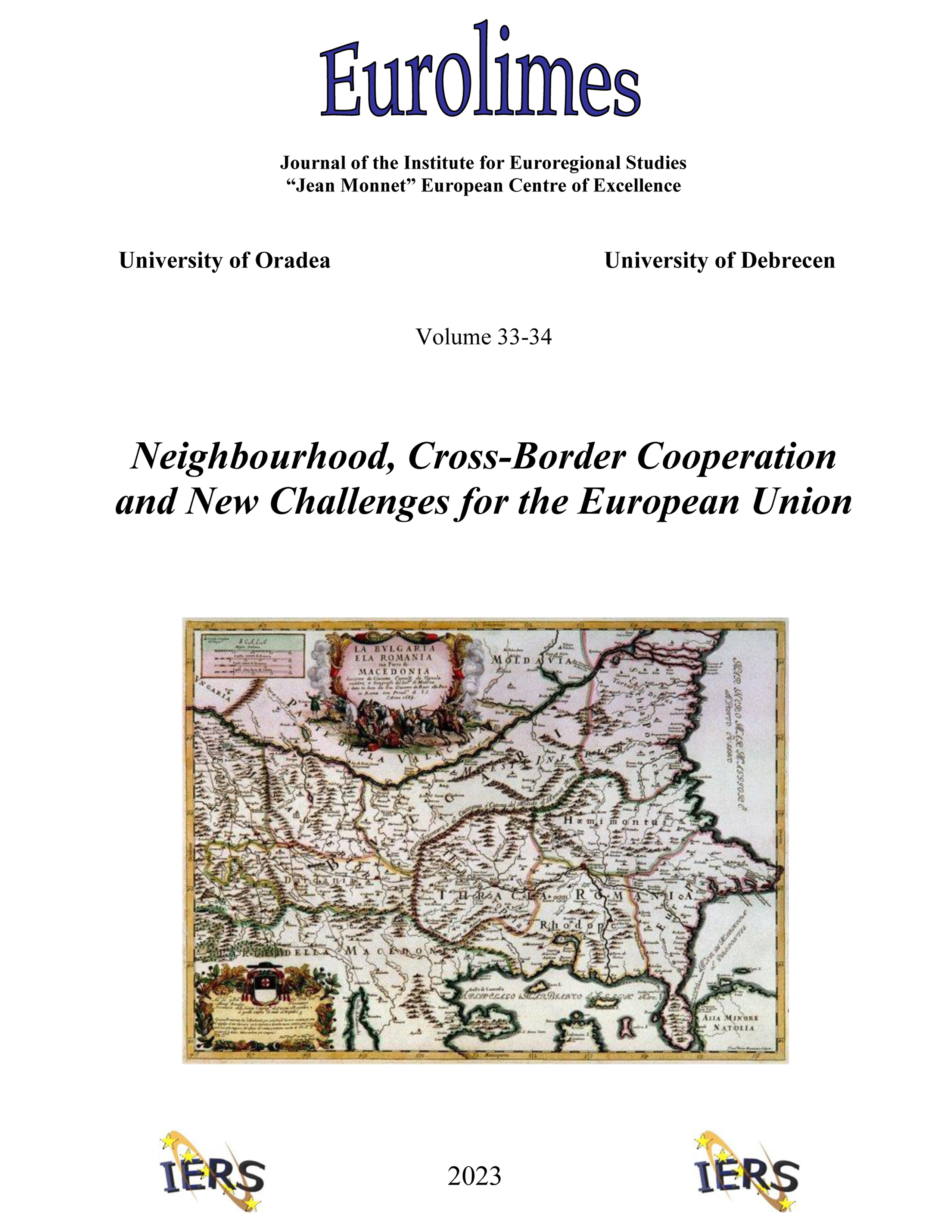
Eastern Neighbourhood: New Realities and Challenges
– Introduction
Eastern Neighbourhood: New Realities and Challenges
– Introduction
Author(s): Ludmila Roșca, János Pénzes, Constantin-Vasile ȚOCASubject(s): Politics / Political Sciences, Politics, Social Sciences, International relations/trade
Published by: Editura Universitatii din Oradea
Keywords: ENP; Ukraine; Belarus; Armenia; EGTC; cross-border cooperation;
Summary/Abstract: Even if not immediately after the end of the Cold War, the concept of neighbourhood has gained an increasingly important place in the European Union, usually associated with the European Neighbourhood Policy (ENP), launched in 2004 and revised in 2015 under the title of Eastern Partnership, to achieve more sustainable cooperation in the EU’s neighbourhood (Moldova, Ukraine, Belarus, Georgia, Armenia, Azerbaijan, Ukraine, Belarus, Moldova, Armenia and Azerbaijan). Three strands of cooperation were thus developed, namely: economic development for stabilisation, security and migration and mobility.1 Within the Community framework, the concept of cross-border cooperation2 the concept of cross-border cooperation operates both at the internal and external borders of the EU, in both cases within the coordination framework of Regional Policy and specific funding programs to achieve the major objective of this process, namely the levelling of disparities across the European Union. The beginnings of cross-border cooperation can be traced back to 1950 when the first Euroregion was set up under the name EUROREGIO, with the participation of the communities of Twente-Oostgelderland (Netherlands), Westmuensterl and Grafschaft Bentheim.
Journal: Eurolimes
- Issue Year: 33/2023
- Issue No: 33-34
- Page Range: 5-16
- Page Count: 12
- Language: English
- Content File-PDF
