
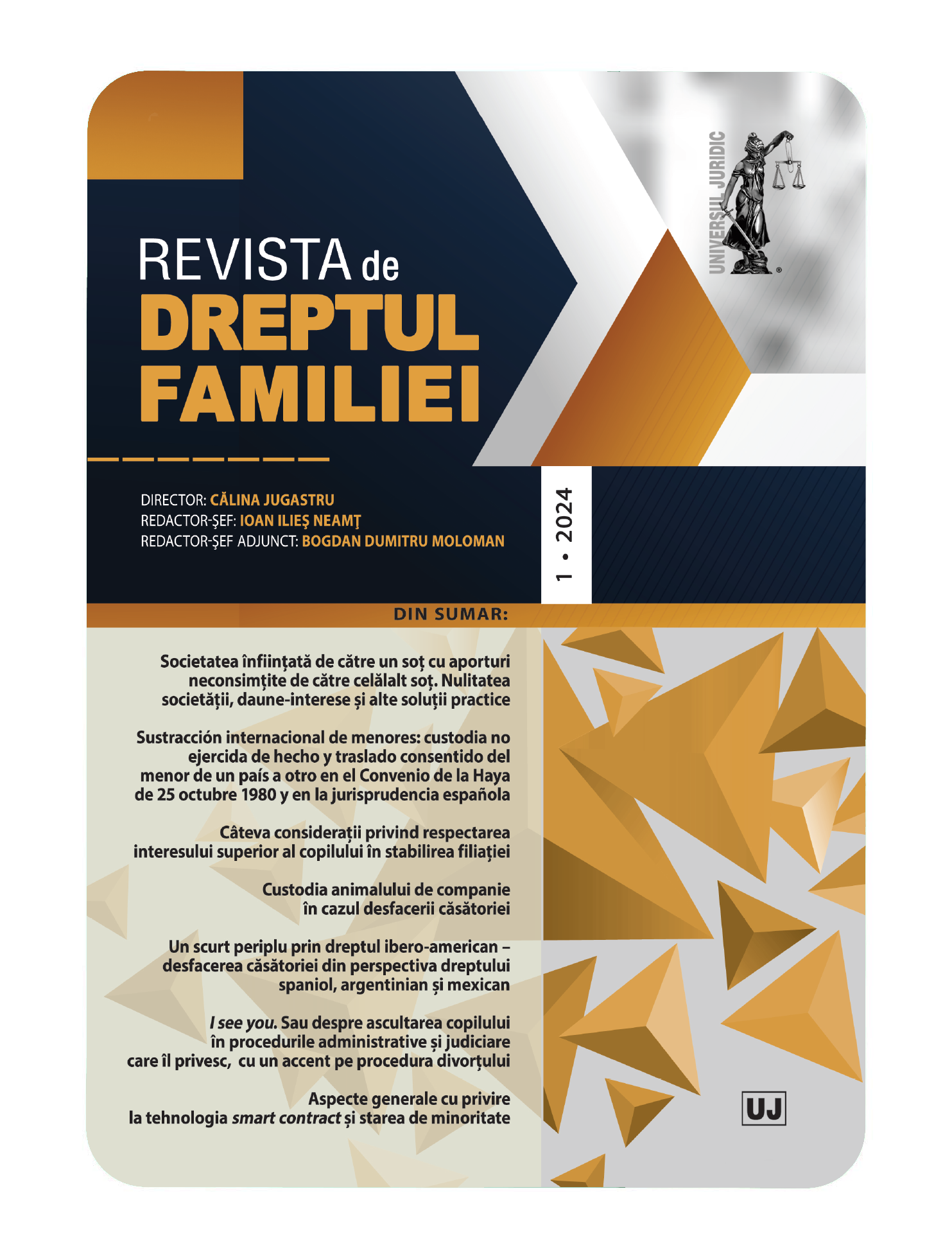
I see you. Sau despre ascultarea copilului în procedurile administrative şi judiciare care-l privesc, cu un accent pe procedura divorţului
I see you. Or on listening to children in administrative and judicial proceedings concerning them, with a focus on divorce proceedings
Author(s): Ioan Ilieş NeamţSubject(s): Law, Constitution, Jurisprudence, Civil Law
Published by: Universul Juridic
Keywords: child hearing; procedure; functions; public notary; judge; divorce; age; maturity;
Summary/Abstract: The paper analyses the problem of the right of the child to be heard in administrative and judicial proceedings that refer to him (with a special focus on the divorce procedure). It aims both to underline the main particularities of this special right belonging to the child and to clarify a series of aspects that seem to have been wrongly implemented in practice. Among others, we have tried to identify, by arguments, the scope of the child’s right to be heard in the judicial proceedings, to clarify the functions of the hearing and how they should be integrated into the procedure, to determine the relevance of the child’s opinion in the process of decision making and how it interferes with the syllogism behind a given solution, and to underline how the child should be heard, mainly in divorce proceedings. The general conclusion is that the child’s hearing is a way more complex process than it may look at first glance, and this complexity derives from the particularities of the one who is being heard, the aim of the hearing, and the procedure under which the hearing takes place. Often, in practice, the child’s hearing is deficient either because it is not properly run or because it is given the wrong functions or scopes. In any case, it must be considered that no matter if the procedure is administrative or judicial, the scope of the child’s hearing and its conditions remain the same at their core. Still, the different nature of the proceeding may lead to distinct consequences in those cases in which the child’s right to be heard is breached or the hearing is wrongly run.
Journal: Revista de dreptul familiei
- Issue Year: 2024
- Issue No: 01
- Page Range: 198-269
- Page Count: 72
- Language: Romanian
- Content File-PDF
