
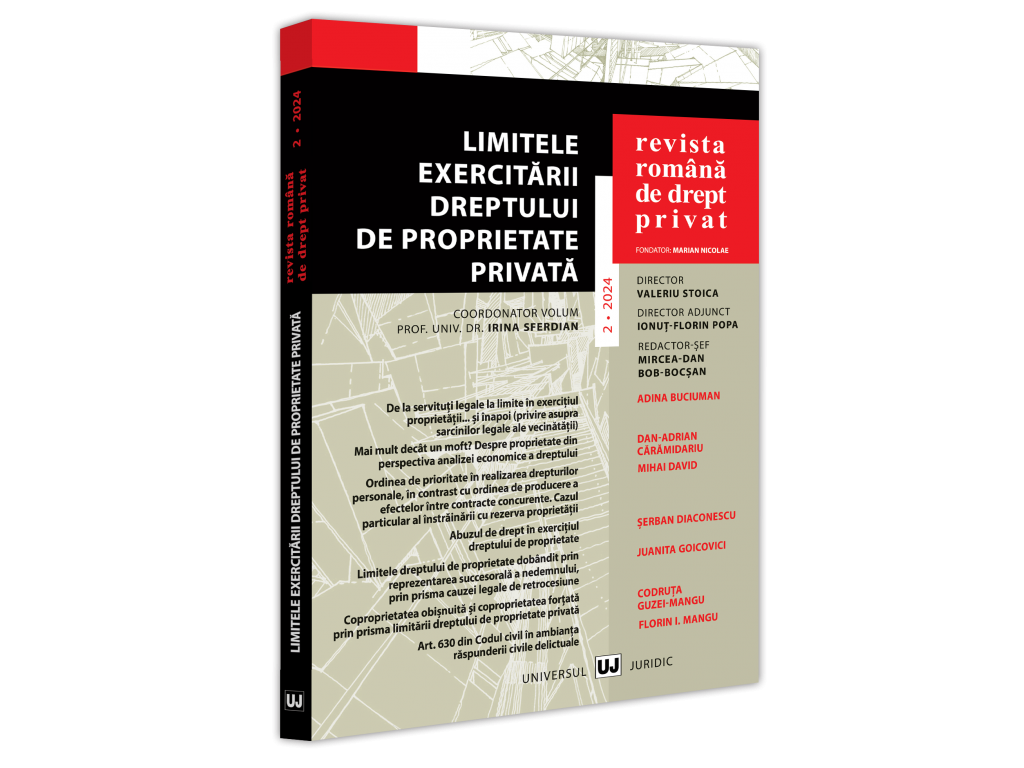
Art. 630 din Codul civil în ambianţa răspunderii civile delictuale
Art. 630 of the Civil Code in the context of tort civil liability
Author(s): Florin ManguSubject(s): Law, Constitution, Jurisprudence, Civil Law
Published by: Universul Juridic
Keywords: property; neighbourhood; inconvenience; prejudice; compensation; equity; abuse of rights; tort liability; good faith; guilt;
Summary/Abstract: Neighbourly relations imply a certain tolerance without which society could not exist. Cohabitation in immediate or mediated geographical proximity burdens, on the one hand, all owners with the tasks inherent in good neighbourliness, arising from the law, custom, or even from the agreements they conclude. On the other hand, it obliges their neighbours to tolerate, within the limits of normality, any infringement of neighbourhood inconveniences, brought to their right or their legitimate interest. However, once the limit of normal has been transgressed, the nuisance of neighbourliness obliges the owner whose conduct is the source of it to pay compensation and, as far as possible, to take measures aimed at restoring the previous situation, although the exercise by him of his right to property meets the requirements of good faith, falling within its external and internal limits. If the owner carries out an activity necessary or useful to his patrimony, and the neighbourhood inconvenience thus caused is minor in relation to the necessity or usefulness of the activity carried out, he will be allowed to continue that activity, but he will be obliged to compensate his neighbour for it, by paying compensation. Even in the absence of damage, in the face of the danger of its materialization, the judge may order, using an injunction, at the request of the threatened neighbour, measures to prevent the damage from occurring. The determination of compensation to be paid to the owner whose normal exercise of the right to property causes greater than normal neighbourhood inconveniences will be based on considerations of equity, having regard to the lawfulness of his conduct and his total lack of guilt. Being based on equity, the compensation that the owner will have to pay to the inconvenienced neighbour must not meet the requirements of the principle of full reparation for the damage. The boundary between the normal and the excessive, intolerable neighbourhood nuisance is a relative one, left to the judge’s discretion, who will have to take into account the objective characteristics of the neighbour (gender, age, state of health, profession, if applicable, etc.), respectively the external circumstances in which the inconvenience manifests itself, not having to take into account the applicant’s hypersensitivity, as well as the oversize of the owner’s ego. Any slippage outside the scope of exercising the right of ownership in good faith and within its internal and external limits will constitute an abuse of rights, which will base the owner’s liability for his unlawful, prejudicial act on his guilt.
Journal: Revista Română de Drept Privat
- Issue Year: 2024
- Issue No: 02
- Page Range: 189-212
- Page Count: 24
- Language: Romanian
- Content File-PDF
