
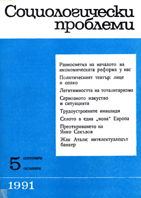
Легитимността на тоталитаризма (към археологията на сталинския властов дискурс)
The Legitimacy of Totalitarianism (A Venture on Stalinist Power Discourse)
Author(s): Albena AzmanovaSubject(s): Social Sciences
Published by: Институт по философия и социология при БАН
Summary/Abstract: The social "normality" and historic logic of Bolshevik-type regimes in East Europe (in contrast to their interpretation as political "deviations") are the point of challenge, of this investigation. The attempt for an "immanent critique" of Stalinism, i. e. its identification from the point of view of its own premises and inner determination is performed in the frame of R. Barthes and M. Foucault's concept of "multiplicity of power". Thus, due to the de¬pendence of the political model on the cultural context of the European East, the Stalinist power discourse contains (and makes explicit) the features of the peculiar historicity of totalitarianism, the con¬ditions, that have made it a real (ergo-natural) his¬toric being. In this aspect the definite type of power (the bolshevic one) is considered a symptom (and not a cause) of a certain historic condition of the social totality, the source of its legitimacy being the norms of intersubjectivity and everyday attitude typical of East European periphery. The genealog of totalita¬rianism is traced out in the interconnection: type of political power — mechanisms of socialisation and in¬novation — and their corresponding sources of power authority. The introduced conceptual frame "power — social context" reduces the issue of the "guilt" of mar¬xism for the legitimation of bolshevic politics to the question of why the intellectual projects of West European radicalism, directed to a post-capi¬talist and post-modern state have proved inadequate to the modern West but feasible to a non-modern society, what Russia was in the beginning of the XX century. In this connection the social conditions in West Europe and Russia are compared from the point of view of the interdependence between the quality of social state, the intellectual projects and the types of political practice. In the end the article treats some of the denota¬tions of the anti-totalitarian revolutions as concer-vative actions; signes, immanent in the probabili¬ty that the mechanisms of East European totali¬tarianism consist in the reflex of "import" of foreign social models — be it according to the prescriptions of West European Marxism or to those of Western economic liberalism. This social reflex, typical of East European innovation is interpreted, in its turn in the terms of the weakness (or lack) of civil society's structures and the permanent crisis of social iden¬tity in this region.
Journal: Социологически проблеми
- Issue Year: 23/1991
- Issue No: 5
- Page Range: 21-30
- Page Count: 10
- Language: Bulgarian
- Content File-PDF
