
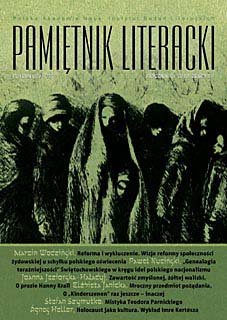
Holocaust jako kultura. Wykład Imre Kertésza
The Holocaust as Culture. Imre Kertész’s Lecture
Author(s): Ágnes HellerSubject(s): Literary Texts
Published by: Instytut Badań Literackich Polskiej Akademii Nauk
Keywords: Imre Kertész; Kertész’s “Táborok maradandósága”; Kertész’s “Hosszú; sötét árnyék”; Kertész’s “A Holocaust mint kultúra”
Summary/Abstract: Ágnes Heller’s text is devoted to three essays by a Hungarian Nobel prize winner, Imre Kertész, namely “Táborok maradandósága” (Imperishability of the Nazi Camps), “Hosszú, sötét árnyék” (Long, Dark Shadow), and “A Holocaust mint kultúra” (The Holocaust as Culture). The researcher analyses the different meanings of the theses that Kertész submits and the issues related to the experience of the Holocaust. Special attention is paid to the interpretation of the role that the “spirit of the novel” plays in Nietzschean world after God’s death. Heller also questions for the answer whether the Extermination experience which imbalanced the values of European humanism may be repeated. An important part of Heller’s reflection is an analysis of two greatest traumas of our times, i.e. the Holocaus and the Gulag, which she sees as two vital myths shaping our consciousness. The Holocaust denotes an ultimate symbol of a broken Agreement and violation of the Law, both established by religion and European humanism, while the Gulag is a political myth and a metaphor of a totalitarian society.
Journal: Pamiętnik Literacki. Czasopismo kwartalne poświęcone historii i krytyce literatury polskiej
- Issue Year: 2010
- Issue No: 4
- Page Range: 103-109
- Page Count: 7
- Language: Polish
